Prestige Science Journalism & Deep-Dive Research Expositions
01 / Quantum ChaosJune 2026
The Subatomic Sledgehammer: Mapping Quantum Impact Chaos
Dr. Arnab Acharya•Weizmann Institute of Science
In the standard lore of quantum mechanics, subatomic systems are typically depicted as smooth, continuous, and highly symmetrical. We model electrons moving in harmonic potential wells or waves flowing unobstructed through empty space. But real-world systems are rarely so polite. What happens when a quantum wavefunction is subjected to rigid, non-smooth boundaries—in effect, crashing headfirst into an impenetrable wall?
Dr. Arnab Acharya’s pioneering research on driven quantum impact oscillators explores this exact regime. When a classical particle collides with an infinitely rigid elastic wall, its velocity reverses instantaneously. This abrupt collision shatters the smooth flow of space-time trajectories, introducing "non-smooth" transitions. Translating this mechanical reality to the quantum realm is a mathematical challenge. The Schrödinger equation, which governs quantum waves, relies on continuous second-order derivatives. Instantaneous velocity jumps introduce singularities that break traditional analytic physics frameworks.
By modeling quantum analogs of these classical impact oscillators, Dr. Acharya and his co-authors demonstrated that hard boundaries induce a profound structural transition in wavebehavior. Under periodic driving forces, the quantum wavefunction does not simply diffuse; instead, it undergoes a spectral transition, forming a singular-continuous spectrum. This is the hallmark of quantum chaos—where the wave behavior mimics the infinite complexity of classical chaotic attractors.
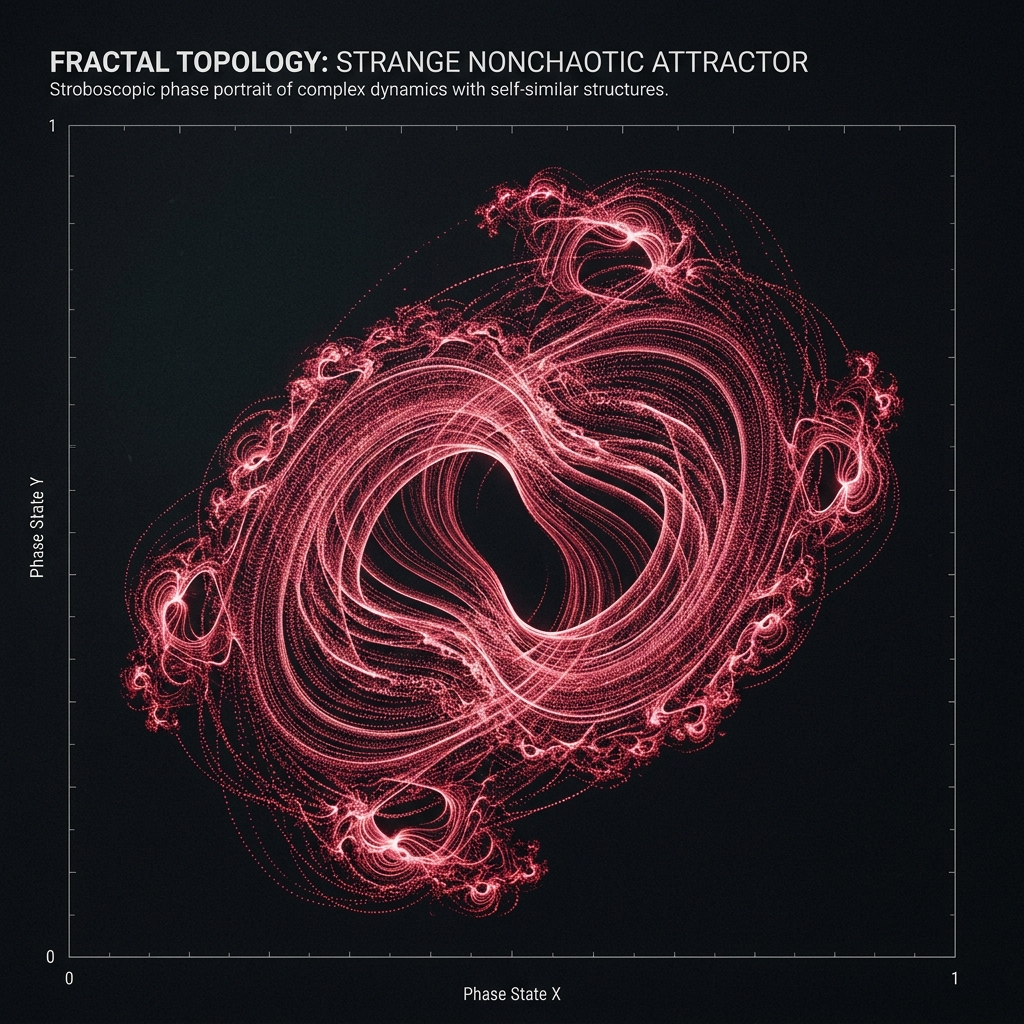
To map this chaotic terrain, Dr. Acharya utilized numerical split-operator Fourier propagation techniques. By solving the time-dependent Schrödinger equation in a stroboscopic fashion (resembling a classical Poincaré section), he diagnosed the emergence of strange nonchaotic attractors (SNAs). These systems are geometrically fractal yet dynamically stable, representing a unique phase of matter that sits on the knife-edge between order and chaos.
These findings are far from purely academic. As we build increasingly microscopic devices, such as quantum nano-cantilevers and arrays of trapped ultracold atoms, physical boundaries and external driving forces become the dominant parameters. Understanding how waves shatter against boundaries allows us to control quantum coherence and design more resilient quantum sensors.
02 / Wavefunction CollapseJune 2026
Where Waves Shatter: The Hidden Geometry of Wavefunction Collapse
Dr. Arnab Acharya•Weizmann Institute of Science
How does a quantum system decide on its physical reality? This question lies at the heart of the quantum measurement problem—a centenary paradox that has puzzled physicists since Niels Bohr and Albert Einstein. In standard quantum theory, a particle exists in a cloud of simultaneous possibilities (superposition) until an external, abstract "observer" makes a measurement. At that instant, the wavefunction is said to collapse, choosing a single state. But what constitutes an observer? Does a wavefunction require a conscious mind to collapse, or is there a mechanical, objective process that triggers it?
Dr. Acharya’s research in objective collapse models tackles this paradox by proposing a physical trigger: interaction with macroscopic objects. Rather than relying on the mysterious act of measurement, this model incorporates a mathematical mechanism where spontaneous collapse is driven by the neighboring geometry of physical matter.
Wavefunction Probability | Hover Mouse inside Container to Induce Quantum Wave Collapse
In Dr. Acharya's formulation, when a quantum particle is positioned near a macroscopic object (like a tiny sensor or a microscopic mirror), the gravitational and environmental couplings act as continuous, passive measurement channels. This interaction drives the off-diagonal elements of the system’s density matrix (which represent quantum coherence and superposition) to zero at an exponential rate.
The beauty of this framework is that the collapse rate is directly proportional to the mass density and proximity of the macroscopic object. By carefully positioning macro-objects, we can systematically control where and how fast the wavefunction collapses. This research provides a critical bridge between quantum microscopic fuzziness and classical macroscopic certainty, paving the way for tabletop experiments to test the boundaries of quantum superposition.
03 / Quantum CosmologyJune 2026
Saddle Points in the Dark: Taming Singularities in Early Spacetime
Dr. Arnab Acharya•Weizmann Institute of Science
At the origin of our universe, Einstein's theory of general relativity predicts a singularity—a point of infinite density and curvature where the laws of physics break down. To understand what truly occurred during the Big Bang, we must merge gravity with quantum mechanics. In quantum cosmology, the path integral formulation expresses the probability of spacetime structures by summing over all possible universe geometries. Yet, in Lorentzian spacetime, this sum is a mathematical nightmare: it involves integrating highly oscillatory complex functions that diverge and fail to yield meaningful answers.
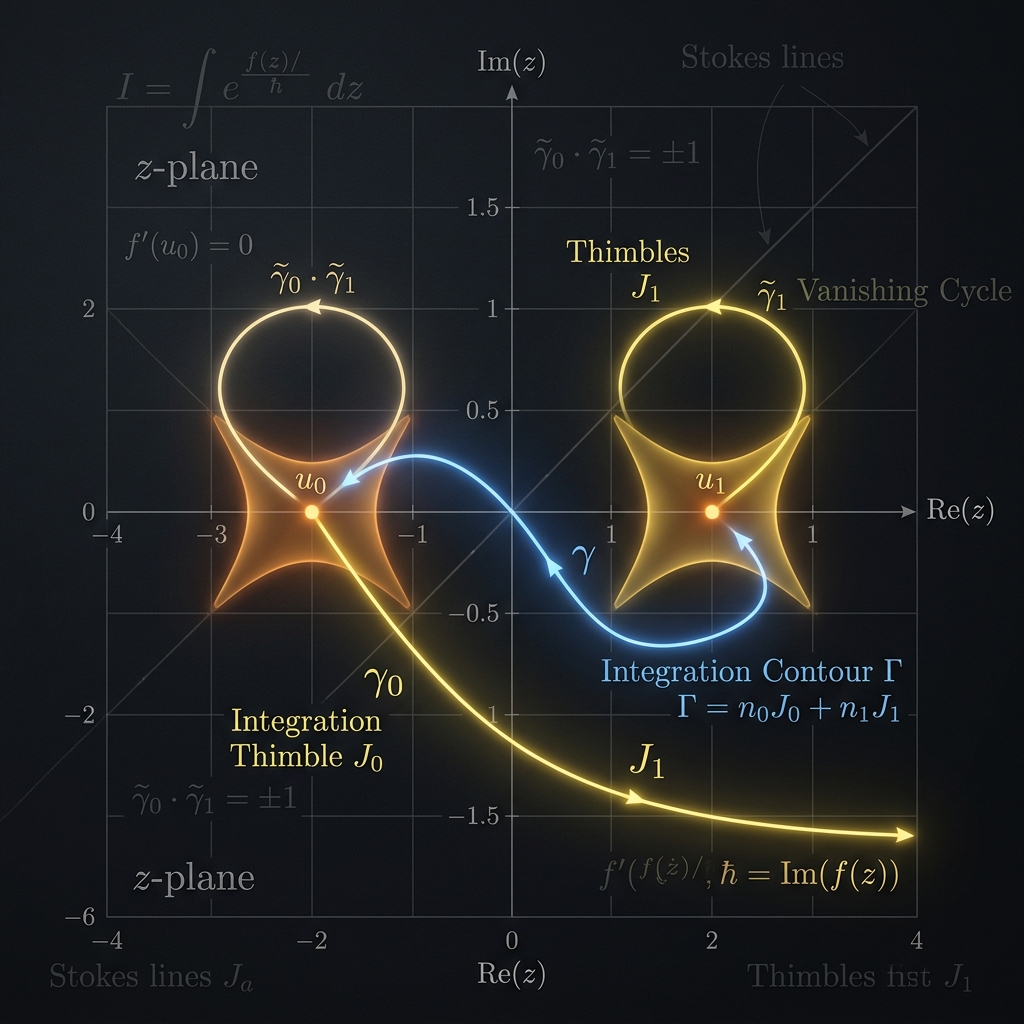
To bypass this roadblock, Dr. Acharya and his collaborators analyzed anisotropic early-universe models (specifically, the Kantowski-Sachs cosmology) using a tool from complex analysis called Picard-Lefschetz theory. Rather than integrating over real physical dimensions—where waves oscillate wildly and cancel each other out destructively—they complexified the spatial coordinates, deforming the integration paths into the complex plane.
Complex Lefschetz Contours | Move Mouse to Alter Saddle Points & Stable Integration Valleys
Under Picard-Lefschetz theory, the integration path wraps around stable, multidimensional geometric contour sheets called Lefschetz thimbles. These thimbles pass through complex saddle points where the imaginary part of the physical action is constant, causing the oscillatory term to decay exponentially. The integral becomes convergent and stable.
By evaluating cosmological path integrals along these complex thimbles, Dr. Acharya’s work demonstrates how early singularities can be smoothed out. The classical singularity is replaced by a quantum transition, where the anisotropic universe emerges smoothly from complex geometric contours. This complexification of spacetime provides a clean, convergent path to modeling the birth of the cosmos.
04 / Open Quantum SystemsJune 2026
Thermal Whisperers: How an Anharmonic Molecule Loses Its Quantum Memory
Dr. Arnab Acharya•Weizmann Institute of Science
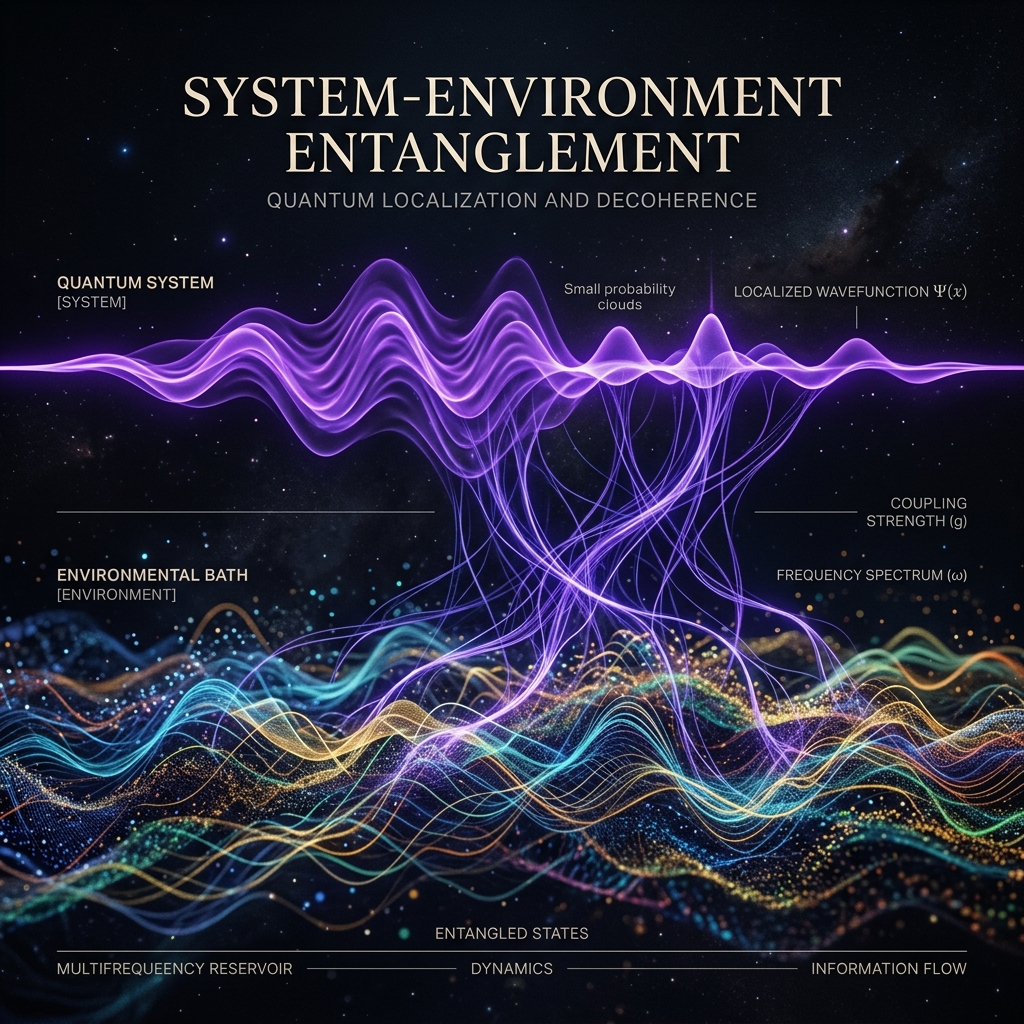
In textbook quantum mechanics, a particle's quantum state—its superposition of being here and there, spin-up and spin-down—is an exquisitely fragile thing. The moment it interacts with anything in its environment, this delicate coherence dissolves. We call this process decoherence, and it is the central obstacle standing between us and practical quantum computers, quantum sensors, and quantum communication networks. Understanding it precisely, for realistic molecules, is one of the central challenges of modern quantum physics.
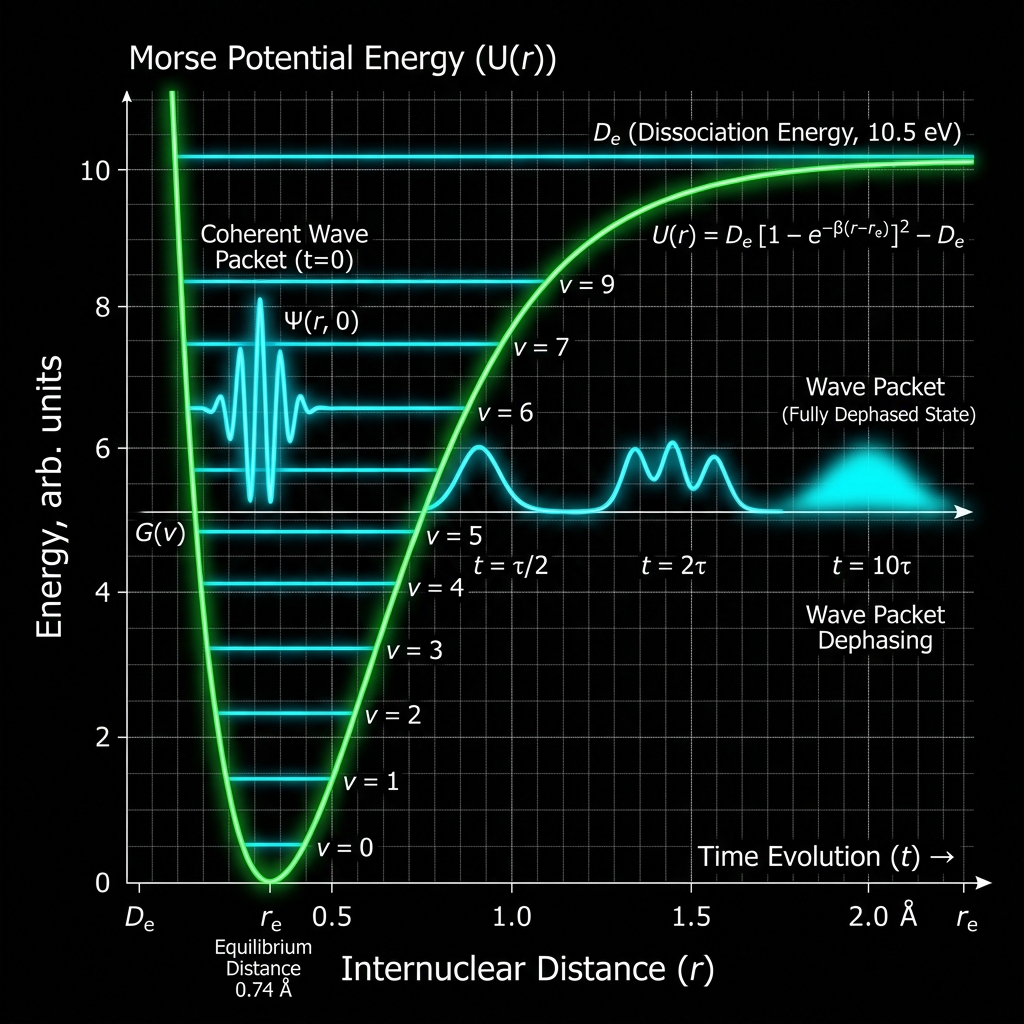
Most theoretical treatments of decoherence use the harmonic oscillator—a particle in a bowl-shaped potential—as a stand-in for real molecules. It is mathematically tractable, but it misses the essential physics of real chemical bonds. Real bonds are anharmonic: the potential well is asymmetric, and at high energies it opens up and allows the molecule to dissociate. The Morse oscillator is a far more realistic model, faithfully capturing this asymmetry, the finite number of bound states, and the dissociation threshold.
Dr. Acharya and collaborators placed the Morse oscillator in an unusual but physically profound regime: a dissipationless environment. This is a bath that induces dephasing—it scrambles the quantum phases between energy states and destroys coherence—but crucially, it does so without any exchange of energy. There is no heating, no cooling, no friction. Yet the quantum memory evaporates nonetheless.
The key finding is striking: the Morse oscillator decoheres faster than a harmonic oscillator under equivalent environmental conditions. Anharmonicity amplifies decoherence. This has direct practical consequences for quantum chemistry and molecular control. Any scheme that uses molecular vibrations to store or process quantum information must account for the fact that real chemical bonds are inherently more vulnerable to environmental noise than the idealized textbook models suggest.
05 / Nonlinear DynamicsJune 2026
Orbits of the Strange: When Quantum Systems Dwell at the Edge of Chaos
Dr. Arnab Acharya•Weizmann Institute of Science
In classical physics, the line between order and chaos is sharp and well-studied. On one side lie regular orbits—periodic or quasiperiodic—that trace predictable paths. On the other side lies chaos, where tiny differences in initial conditions bloom into wildly divergent trajectories. Yet between these two realms, mathematicians discovered a third possibility: the strange nonchaotic attractor (SNA). It is geometrically strange—its structure is fractal, infinitely wrinkled at every scale—yet dynamically nonchaotic: nearby trajectories do not diverge exponentially. It is the most exotic state in all of nonlinear dynamics.
SNAs arise naturally when a classical system is driven by two incommensurate frequencies—two tones with an irrational frequency ratio. The mathematical forcing is forever quasi-periodic, never exactly repeating, yet also never fully random. Dr. Acharya's research asks: can a quantum system—one obeying the Schrödinger equation rather than Newton's laws—exhibit the fingerprints of an SNA?
Stroboscopic Phase Map | Mouse X → Quasiperiodic Frequency Ratio | Fractal SNA geometry emerges
This is not a trivial question. Quantum closed systems evolve unitarily, and unitary evolution preserves entropy. True chaos—in the sense of exponential sensitivity—is impossible for a closed quantum wavefunction. Yet the geometry of the dynamics can still be reflected in the quantum system's behaviour through the spectral statistics and the structure of its probability density when sampled stroboscopically.
To test this, Dr. Acharya and his colleagues constructed the quantum analog of a classical impact oscillator driven at two incommensurate frequencies. By computing the wavefunction numerically at stroboscopic time intervals—sampling the state after each complete cycle of the slower drive—they built up a phase portrait analogous to the classical Poincaré section. The resulting structure in the quantum probability density was unmistakably fractal: a smooth-looking set that, upon magnification, revealed ever-finer wrinkles and self-similar layers.
06 / Quantum MeasurementJune 2026
Quantum Stopwatches: What Repeated Observation Does to a Trapped Particle
Dr. Arnab Acharya•Weizmann Institute of Science
The ancient paradox of Zeno's arrow—an arrow in flight that, if frozen at every instant, appears stationary—finds a surprising and rigorous echo in quantum mechanics. If you measure a quantum system frequently enough, you can actually prevent it from evolving. This is the quantum Zeno effect: measurement, rather than being a passive act of looking, actively reshapes the trajectory of a quantum system.
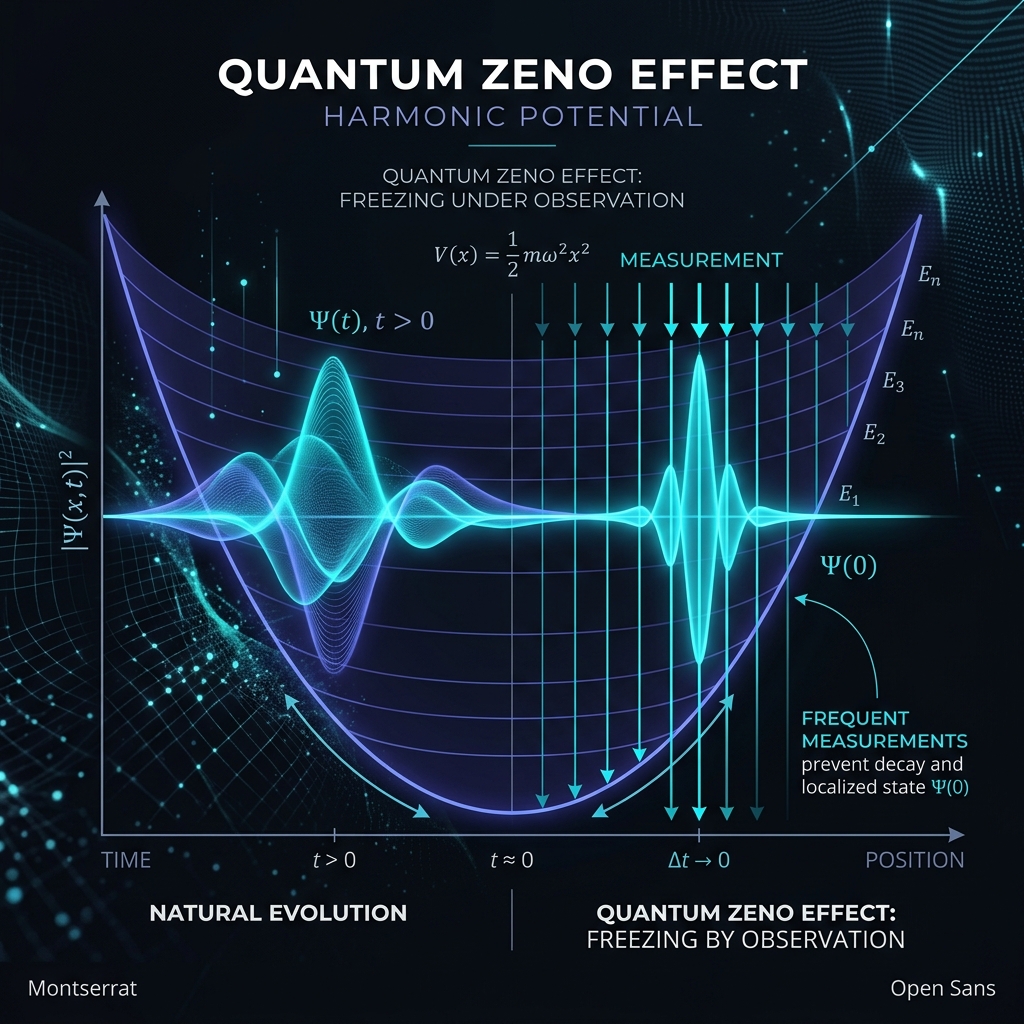
Dr. Acharya and collaborators explored a specific and precisely solvable version of this phenomenon: a quantum particle trapped in a harmonic potential well, whose position is measured repeatedly at regular time intervals. After each measurement, the wavefunction collapses to a sharp position eigenstate, then immediately begins spreading again under the harmonic potential before the next measurement.
Harmonic Well Zeno Dynamics | Mouse X → Measurement Rate | High rate freezes the wavepacket
The analysis reveals that the limiting distribution depends critically on the ratio of the measurement period to the natural oscillation period of the harmonic well. When measurements are frequent compared to the oscillation period, the distribution becomes tightly concentrated—the Zeno effect localises the particle near its initial position. As the measurement interval lengthens, the distribution broadens and eventually approaches the thermal equilibrium distribution of the oscillator.
07 / Quantum FoundationsJune 2026
Fermions and Fuzziness: The Physical Mechanism of Interaction-Induced Collapse
Dr. Arnab Acharya•Weizmann Institute of Science
The measurement problem is quantum mechanics' oldest wound. Every time we observe a quantum system, the wavefunction—which was spread across many possible outcomes—instantly resolves into a single definite result. This "collapse" is not described by the Schrödinger equation. It is an axiom, a rule appended to the theory from outside, with no mechanistic explanation. For ninety years, physicists have debated what actually causes it.
One powerful class of proposals—objective collapse theories—postulates that collapse is a real physical process, not just an update of our knowledge. It happens spontaneously, triggered by some physical property of the system. The Ghirardi-Rimini-Weber (GRW) model and its relatives propose that collapse occurs randomly, with a rate proportional to the number of particles. Larger, heavier objects collapse faster, which is why we never see a cat in a superposition of alive and dead.
Dr. Acharya's work takes a different and more mechanistic approach: what if collapse is not random, but is instead triggered specifically by the interaction between a quantum system and a neighbouring macroscopic object? Not an abstract observer—a physical object with mass and spatial extent, coupled to the quantum system through ordinary physics.
The model works through entanglement. When the quantum system (say, a single particle) interacts with the macroscopic object, their states become entangled: the quantum state of the particle becomes correlated with an enormous number of degrees of freedom inside the macroscopic object. From the perspective of the particle alone—described by its reduced density matrix, obtained by tracing out the environment—this entanglement looks exactly like decoherence. The off-diagonal elements of the density matrix, which encode superposition, decay.